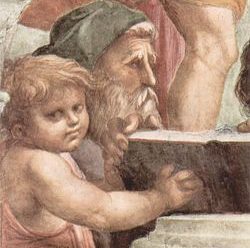
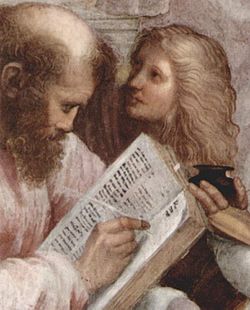
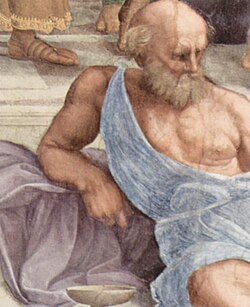
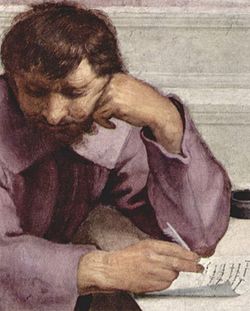
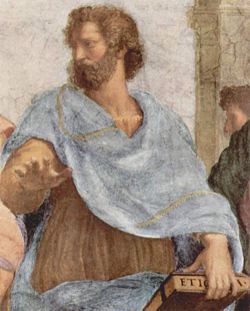
The identities of some of the philosophers in the picture, such as Plato and Aristotle, have been ascertained. Several other of Raphael’s figures have been the subject of conjecture. Some have received multiple identifications, both as depictions of ancients and as portraits of Raphael’s contemporaries. Vasari mentions a portrait of the young Duke of Mantua, leaning over Bramante with his hands raised near the bottom right, and a self-portrait of Raphael himself.
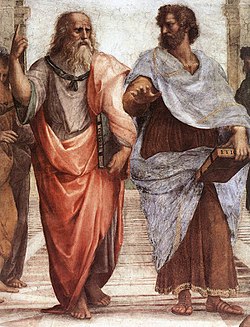
In the center of the fresco, at its architecture’s central vanishing point, are the two undisputed main subjects: Plato on the left and his student Aristotle on the right. Both figures hold contemporary (of the time of painting) bound copies of their books in their left hands, while gesturing with their right. Plato holds Timaeus and Aristotle holds his Nicomachean Ethics.
Plato is depicted as old, grey, and barefoot. By contrast, Aristotle, slightly ahead of him, is in mature manhood, wearing sandals and gold-trimmed robes, and the youths about them seem to look his way. In addition, these two central figures gesture along different dimensions: Plato vertically, upward along the picture-plane, into the vault above; Aristotle on the horizontal plane at right-angles to the picture-plane (hence in strong foreshortening), initiating a flow of space toward viewers.
It is popularly thought that their gestures indicate central aspects of their philosophies: for Plato, his Theory of Forms, and for Aristotle, an emphasis on concrete particulars. Many interpret the painting to show a divergence of the two philosophical schools. Plato argues a sense of timelessness whilst Aristotle looks into the physicality of life and the visible world.